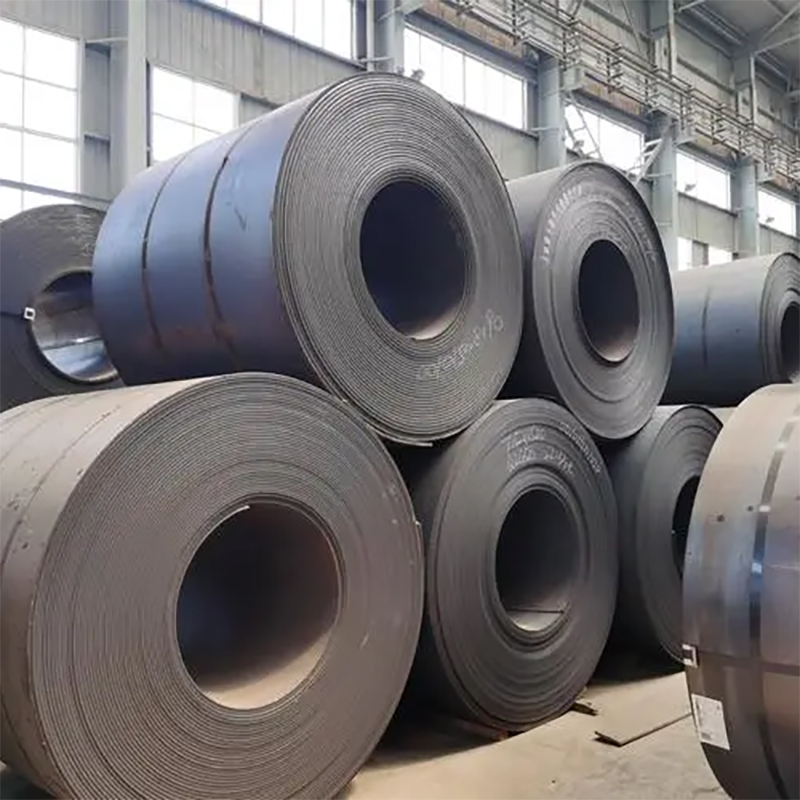
Hot rolled steel coil is an important steel product in the construction, manufacturing, and metal processing industries. Many factories use it to produce steel pipes, structural components, machinery parts, and other metal products.
Thanks to its wide range of applications and practical production advantages, hot rolled steel coil has become a popular choice for manufacturers and steel distributors around the world.
But what exactly is hot rolled steel coil? How do manufacturers produce it, and why do so many industries rely on this material?
In this guide, we will explain what hot rolled steel coil is, explore its common uses, and discuss its main advantages. We will also share a few tips to help you choose the right product for your business.
1. What Is Hot Rolled Steel Coil?
Hot rolled steel coil is a flat steel product that manufacturers produce by heating steel above its recrystallization temperature and passing it through rolling mills. The rolling process reduces the steel’s thickness and forms it into a long, continuous strip.
After rolling, manufacturers coil the steel strip for easier storage, transportation, and further processing.
Compared with cold rolled steel, hot rolled steel usually has a rougher surface and less precise dimensional tolerances. However, it offers practical advantages for many applications that do not require a very smooth finish or extremely tight thickness tolerances.
Hot rolled steel coils come in different thicknesses, widths, grades, and surface conditions. Buyers can select the right specifications according to their manufacturing processes and final products.
In simple terms, hot rolled steel coil provides a versatile starting material for many steel fabrication and processing operations.
2. How Do Manufacturers Produce Hot Rolled Steel Coil?
The hot rolling process involves several important steps. Each step helps manufacturers achieve the required dimensions and material properties.
Step 1: Heat the Steel Slab
First, manufacturers heat a steel slab in a furnace until it reaches a suitable rolling temperature. The high temperature makes the steel easier to shape and reduces the force required during rolling.
Step 2: Roll the Steel
Next, the hot slab passes through rolling mills. These machines apply pressure and gradually reduce the steel’s thickness while increasing its length.
Manufacturers control the rolling process to achieve the required dimensions and material characteristics.
Step 3: Cool the Steel Strip
After rolling, the steel strip moves through a controlled cooling process. The cooling conditions influence the steel’s final microstructure and mechanical properties.
Step 4: Coil the Steel
Finally, a coiler winds the long steel strip into a compact coil. This form makes the material easier to handle, transport, store, and process at a later stage.
Once production finishes, buyers can purchase the coils for direct processing or further manufacturing.
3. What Are the Main Uses of Hot Rolled Steel Coil?
Hot rolled steel coil serves many industries because manufacturers can cut, form, weld, and process it into different products. Here are some of its most common applications.
3.1 Steel Pipe and Tube Manufacturing
Steel pipe manufacturers often use hot rolled steel coils or strips as raw materials. They cut the material to the required width, form it into a tubular shape, and weld the edges to produce steel pipes or tubes.
These products serve applications such as construction, industrial equipment, infrastructure, and general engineering.
The suitable steel grade and thickness depend on the pipe’s intended use and required performance.
3.2 Construction and Structural Components
The construction industry uses hot rolled steel in many structural and fabricated products. Manufacturers can process suitable grades into beams, channels, brackets, frames, and other steel components.
Hot rolled steel also serves as a starting material for certain structural sections and construction accessories.
For projects that require specific load-bearing performance, buyers should check the steel grade, mechanical properties, and applicable standards before selecting a product.
3.3 Automotive Manufacturing
Automotive manufacturers use hot rolled steel in selected vehicle components, chassis parts, brackets, and other structural or mechanical applications.
Its strength and processing flexibility make it useful for components that require durability and practical manufacturing costs.
However, not every automotive part uses hot rolled steel. The material choice depends on the component’s shape, weight requirements, surface quality, and performance specifications.
3.4 Machinery and Industrial Equipment
Factories use hot rolled steel coil to manufacture machine frames, equipment bases, industrial brackets, and various metal components.
Manufacturers often choose this material when they need a practical balance of strength, formability, and cost.
In addition, steel processors can cut the coils into sheets or strips to suit different production lines.
3.5 Metal Fabrication and General Manufacturing
Hot rolled steel coil supports a wide range of metal fabrication processes. Manufacturers can cut it into sheets, slit it into narrow strips, or use it to produce parts through bending, forming, and welding.
For example, a steel service center may process a large coil into smaller sheets for equipment manufacturers or construction suppliers.
This flexibility helps businesses use the same basic material across different production processes.
3.6 Agricultural Equipment and Storage Products
Manufacturers also use suitable hot rolled steel grades to produce agricultural machinery components, storage equipment, support frames, and other fabricated products.
These applications often require materials that can handle everyday mechanical demands without adding unnecessary production costs.
Buyers should still select the appropriate grade and thickness based on the equipment’s operating conditions.
4. What Are the Advantages of Hot Rolled Steel Coil?
Hot rolled steel coil offers several benefits that make it attractive to manufacturers, steel processors, and distributors.
4.1 Cost-Effective Production
Hot rolling allows manufacturers to process large volumes of steel efficiently. For many applications, it offers a cost-effective alternative to cold rolled steel because it does not require the same cold reduction process and associated finishing operations.
As a result, hot rolled steel often suits projects that prioritize practical performance and production efficiency over a very smooth surface.
However, the final price still depends on the steel grade, dimensions, market conditions, processing requirements, and order quantity.
4.2 Good Formability for Many Applications
High temperatures make steel easier to deform during the rolling process. Manufacturers can therefore produce long strips in a wide range of thicknesses and widths.
Many hot rolled steel grades also work well in subsequent forming and fabrication operations.
The exact formability depends on the steel grade and its mechanical properties, so buyers should confirm that the material meets the requirements of their production process.
4.3 Suitable Strength and Durability
Hot rolled steel comes in different grades with different mechanical properties. Many grades offer suitable strength and durability for structural components, machinery, and general fabrication.
This makes hot rolled steel coil a practical material for products that must handle everyday mechanical loads.
For demanding applications, always check the specified yield strength, tensile strength, elongation, and other relevant properties instead of relying on the product name alone.
4.4 Flexible Processing Options
Manufacturers can process hot rolled steel coils in several ways. They can slit coils into narrow strips, cut them into sheets, or feed them directly into suitable forming and fabrication lines.
This flexibility helps steel processors supply material in the formats their customers need.
Furthermore, coil packaging allows manufacturers to handle long steel strips efficiently during large-scale production.
4.5 Wide Range of Applications
Hot rolled steel coil supports many industries, including construction, automotive manufacturing, machinery, agriculture, and general metal fabrication.
Its versatility gives buyers more options when planning different products and production processes.
By selecting the right steel grade and dimensions, manufacturers can use hot rolled steel as a reliable starting material for a broad range of applications.
5. Hot Rolled Steel Coil vs. Cold Rolled Steel Coil
Hot rolled and cold rolled steel coils may look similar at first, but they differ in production methods, surface quality, dimensional accuracy, and common applications.
| Feature | Hot Rolled Steel Coil | Cold Rolled Steel Coil |
|---|---|---|
| Production | Rolls steel at high temperatures | Further rolls steel at or near room temperature after prior processing |
| Surface | Usually rougher, often with mill scale | Usually smoother and more uniform |
| Dimensional accuracy | Generally wider tolerances | Generally tighter tolerances |
| Typical cost | Often lower for comparable basic applications | Often higher because of additional processing |
| Common uses | Pipes, structural components, general fabrication | Appliances, precision parts, and applications requiring better surface quality |
So, which one should you choose?
If your project needs a cost-effective material for steel pipes, structural components, or general fabrication, hot rolled steel coil may be a suitable option.
On the other hand, if your product requires a smoother surface and tighter dimensional tolerances, cold rolled steel may offer a better fit.
Neither option works best for every situation. The right choice depends on the product design, processing method, quality requirements, and budget.
6. How to Choose the Right Hot Rolled Steel Coil
Before placing an order, consider several important factors to make sure the product meets your requirements.
6.1 Steel Grade
Different steel grades offer different chemical compositions and mechanical properties. Start by identifying the grade your application requires.
If your customer or production line specifies a particular standard, confirm that the supplier can provide the correct material grade and supporting documentation.
6.2 Thickness and Width
Thickness and width directly affect the way you process the steel coil.
For example, a steel pipe manufacturer may require a specific strip width and thickness to match its forming and welding equipment. A metal fabrication company may need different dimensions for cutting and bending.
Always confirm the required dimensions before purchasing.
6.3 Coil Weight and Inner Diameter
Coil weight influences transportation, storage, and handling. Meanwhile, the inner diameter must match the equipment used to load and process the coil.
Before ordering, check your production line’s capacity and confirm that the coil specifications suit your equipment.
6.4 Surface Condition
Hot rolled steel often has a dark surface with mill scale. This condition works well for many general industrial applications, but some downstream processes may require descaling, pickling, or additional surface treatment.
Therefore, discuss the required surface condition with your supplier before placing an order.
6.5 Supplier Reliability and Quality Control
A reliable supplier should provide clear product specifications and consistent quality. Depending on your needs, you may also want to check inspection records, material test certificates, packaging details, and export experience.
For international orders, discuss shipping arrangements, delivery schedules, and packaging requirements in advance. Clear communication helps reduce misunderstandings and keeps your purchasing process more efficient.
7. Frequently Asked Questions About Hot Rolled Steel Coil
Is hot rolled steel coil suitable for outdoor use?
Hot rolled steel can serve many outdoor applications, but ordinary carbon steel can rust when exposed to moisture and oxygen. For long-term outdoor use, you may need painting, galvanizing, or another suitable corrosion protection system.
The best solution depends on the environment and the product’s service life requirements.
Can manufacturers turn hot rolled steel coil into steel sheets?
Yes. Steel processors can uncoil the material, flatten it, and cut it into sheets of the required length. This process allows buyers to purchase hot rolled steel in either coil or sheet form.
Does hot rolled steel coil have a smooth surface?
Hot rolled steel usually has a rougher surface than cold rolled steel. The rolling and cooling processes can also leave mill scale on the surface.
If your application requires a cleaner surface, ask your supplier about pickled and oiled steel or other suitable surface treatments.
How should buyers store hot rolled steel coils?
Store steel coils in a dry, well-ventilated area and protect them from rain, standing water, and unnecessary moisture. Use suitable handling equipment and follow proper storage procedures to reduce the risk of damage and corrosion.
Conclusion
Hot rolled steel coil is a versatile and cost-effective material for many industrial and manufacturing applications. From steel pipes and structural components to machinery and general metal fabrication, it helps manufacturers produce a wide range of products.
Its main advantages include efficient production, flexible processing options, suitable mechanical properties, and broad industrial use.
To choose the right hot rolled steel coil, consider the steel grade, thickness, width, coil weight, surface condition, and intended application. A reliable supplier can also help you confirm specifications and arrange suitable packaging and delivery.
Looking for hot rolled steel coils for your business? Contact our team to discuss your required steel grade, dimensions, coil weight, and surface condition. We can help you find a suitable product for your manufacturing or construction needs.